
The week of July 26, I continued to assist in the Forest Restoration Project with Dr. Aronson. This project was very successful and it helped me significantly with my plant identification. I also began to work on the analysis of my bulbil dispersal experiment. I worked closely with Nick, one of the students from South Side high school, on the preliminary data and made sure that he understood the process of analyzing data in a research project.
The week of August 3, I did some more field work and began to work on the methods section of my paper. I worked with Dr. Sanford on understanding how to use statistical programs and analyzing the data for my bulbil dispersal experiment. We performed a regression analysis on bulbils that had buoyancies below 0 and the ones that had buoyancies above 0. The results showed that there was no relation between the bulbil’s buoyancy and time to sink. However, my research did show that bulbils can travel 0.002 m/sec.
I also performed some more statistical tests on my diversity sampling data with the help of Dr. Aronson. There was a significant difference in species richness between invaded and non-invaded plots at Muttontown Preserve. The average invaded mean was 5.6 and the average non-invaded mean was 7.3. There was no significant difference in diversity between invaded and non-invaded plots at Muttontown Preserve. The invaded mean was 1.31 and the non-invaded mean was 1.04. At Prospect Park, there was no significant difference in species richness between invaded and non-invaded plots. The invaded mean was 1.8 and the non-invaded mean was 1.6. There was not a significant difference between diversity in invaded and non-invaded plots at Prospect Park as well. The invaded mean was 0.46 and the average non-invaded mean was 0.26. The number of plots was limited due to the small size of the invasion as well as environmental conditions that consisted of Norway Maples casting deep shade. Therefore, the skewed results reflect the conditions of the site.
The Greenhouse portion of my experiment was not as successful as I intended it to be. I have not observed any growth, except for a few weeds, and it has been about a month. Therefore, Dr. Aronson and I have decided to remove the flats from the high school and bring them back to Hofstra. We will keep them in a growing chamber, where the lighting conditions would better support the plants. We believe that the seeds have not been stratified long enough. As a result, we will perform a new seed addition and start the process over right away.
Showing posts with label Johanna Andrews. Show all posts
Showing posts with label Johanna Andrews. Show all posts
Wednesday, August 11, 2010

Friday, July 23, 2010
*Greenhouse Greatness!*
Last week, I began the greenhouse portion of my research project. I was extremely happy to start this experiment. On Monday, I made sure that my methods were precise and exact. Also, I prepared all of the materials that we needed to start the experiment. I conducted the experiment on Tuesday at Southside High school in Rockville Centre, Long Island. There were about 4 students present and they were really involved. As a result everything went smoothly. We first mixed soil with activated carbon and placed it into the appropriate treatments of the five species of plants. We did the same for non-invaded soil to avoid potential confounding effects of soil disturbance and mixing. We then added 6 seeds of five different treatments into 40 pots each, totaling 200 pots. We then placed all of the pots randomly in the greenhouse. The plants were watered to saturation with 50 ml of tap water. They will be watered every other day with the same amount and I will check on them periodically throughout the upcoming weeks. When they germinate, I will have all of the students return and assist me in measuring the germination rates.


I also began the revisions to the methods of the bulbil dispersal experiment to make sure that there was no room for error. I created all new data sheets, used all new bulbils and set up stations to ensure that everything would run smoothly. I had two assistants that helped me and we began the project last week. This week, I completed the bulbil dispersal experiment and began to enter all of the new data. I will begin to analyze all of the data next week with the help of Dr. Sanford and Dr. Aronson.


On Tuesday, Dr. Aronson and I went to Alley Pond in New York City to help with a Forest Restoration project . Although, I am always looking forward to being out in the field, we were all eaten alive by malicious mosquitoes, literally! On Thursday, we went to a different site at Roy Wilkins Park in Queens to assist on the same project. This site was way more pleasant and we got a lot accomplished. We have some upcoming sites that I am looking forward to. This is such a great partnership! On Friday, Dr. Aronson and I went over to the high school to check on my plants. Everything looked pretty good and no plants have germinated as yet, except for two weeds. I will return next week to check on them again.


I also began the revisions to the methods of the bulbil dispersal experiment to make sure that there was no room for error. I created all new data sheets, used all new bulbils and set up stations to ensure that everything would run smoothly. I had two assistants that helped me and we began the project last week. This week, I completed the bulbil dispersal experiment and began to enter all of the new data. I will begin to analyze all of the data next week with the help of Dr. Sanford and Dr. Aronson.
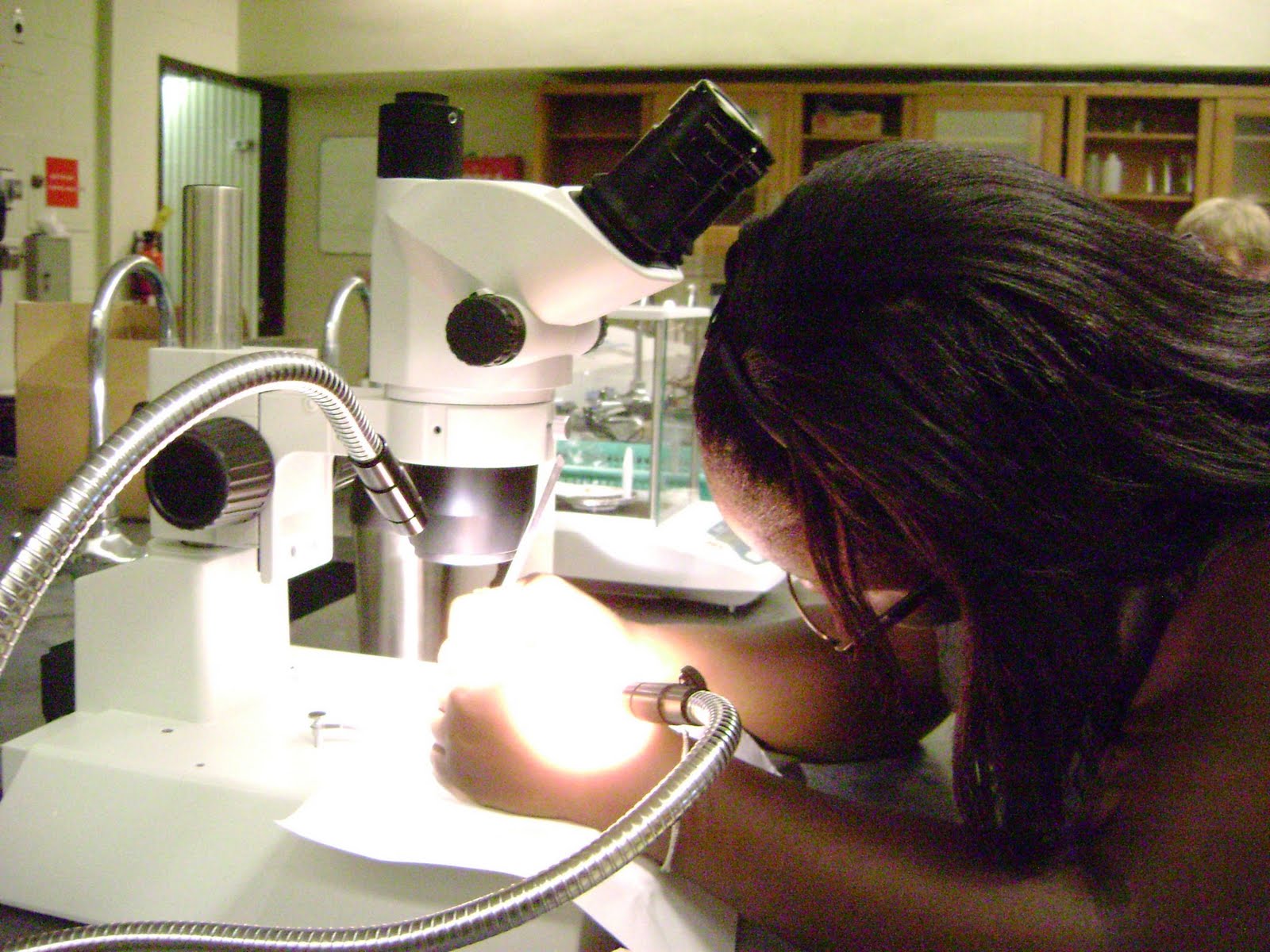


On Tuesday, Dr. Aronson and I went to Alley Pond in New York City to help with a Forest Restoration project . Although, I am always looking forward to being out in the field, we were all eaten alive by malicious mosquitoes, literally! On Thursday, we went to a different site at Roy Wilkins Park in Queens to assist on the same project. This site was way more pleasant and we got a lot accomplished. We have some upcoming sites that I am looking forward to. This is such a great partnership! On Friday, Dr. Aronson and I went over to the high school to check on my plants. Everything looked pretty good and no plants have germinated as yet, except for two weeds. I will return next week to check on them again.
Friday, July 16, 2010
*Revelations in my Research!*
Last week, I continued to work on the project looking at bulbil dispersal. I completed measuring all of the volumes for the bulbils that I am studying. I confirmed my measurements with an assistant in my lab that also took measurements, to make sure that I had repeatable measurements. However, I had an obstacle when it came to the dimensions that I was measuring the bulbils. Dr. Aronson and I were not sure that I was measuring correctly so we researched the process of calculating the volume of an ellipsoid and we realized that I wasn’t quite doing it right. I understood that this was all a part of the research process, even though I was about half way through and it was frustrating to start over.
Ultimately, I calculated the volume, density and buoyancy of these bulbils. I met with Dr. Sanford to discuss what was next in terms of the project and I got started on it right away. I am testing whether my prediction of buoyancy is an accurate measure of the metric in water. I want to simulate how bulbils will sink in a stream, so I used a 10 gallon tank and filled it half way with water. I made sure that there were no currents in the water and got a precise measure of the depth of water. I was very careful to avoid the meniscus effect. I had an assistant with me to calculate the time it took to sink from the surface of water to the bottom of the tank. I was very careful not to touch the water too much by using a long pair of forceps so that the level of water remained the same.
I predicted that the bulbils would have a negative buoyancy which means that they would sink. Most of them did but a lot of them did not. I left them over night to see if anything would happen but unfortunately, I returned to the same results the following morning. The most logical reasoning for the bulbils not sinking was the fact that they began to lose water in the zip lock bags that they were enclosed in, in the freezer. I noticed that when I took the weights of the bulbils after I retrieved them from the water, they actually lost about half of their original mass. Therefore, Dr. Aronson and I decided that we would start the whole experiment over with fresh bulbils that we had stored. This time we agreed that we would do all of the measurements and timing of sinking at one time to prevent the bulbils from drying out between measurements. This is also all a part of the research process. Sometimes it means perfecting an experiment as many times as you need to, in order to ensure that it is successful. I am grateful for all of these experiences because it is helping me to become a better research student.
Myself along with Dr. Aronson, Mr. Weiss, and our Locust Valley High school student all went out to Prospect Park last week Friday to add another site to my diversity sampling of invaded and non-invaded areas. However, there was not much to sample from at this site due to the small size of the invasion and environmental conditions (Norway Maples casting deep shade).
Monday, July 12, 2010
*Getting Down at Muttontown!*
On the week of June 28th, Dr. Aronson and I went out to Muttontown Preserve (http://www.nassaucountyny.gov/agencies/Parks/wheretogo/preserves/north_shore_preserve/Muttontown_Pres.html) to check on our flagged non-invaded areas. We identified some species and flagged the invaded areas of where we would set up our plots. The forest looked absolutely beautiful and the flagged area that we are going to conduct the experiment was perfect.


We went out again later that week to complete our diversity sampling. We teamed up with the research teacher, Mr. Weiss and one student from Southside High school, Nick, as well as another high school student from Locust Valley High school and one of Dr. Aronson’s field assistants from Hofstra. We completed ten plots from the invaded area and ten plots from the non-invaded area. There was a lot of diversity among the forest especially in the non-invaded areas. It really broadened my knowledge to many different species of natives (such as violet, jewel weed, red maple, spice bush, Canada mayflower, may apple, etc.) and non-natives (such as English ivy, garlic mustard, Japanese honeysuckle, etc.) . There was also a lot of poison ivy but we tried our best to avoid it!


 English ivy
 Jewel weed
After the sampling was completed, we collected soil from the non-invaded area as well as the invaded area. The soil will be used in the greenhouse experiment along with our activated carbon to test for allelopathic chemicals being left behind by this invasive species. I also decided on exactly which company I would order the activated carbon from by using scientific literature, searching on the web and contacting companies. We should have it in time for the greenhouse experiment.
We could not identify some of the species in the plots so we carried back samples from the field site. We could only identify one out of the six species that we were not sure about. We identified it by looking at identification books. This was the only species with flowers. However, we pressed the other species in the lab to save for later identification and we plan to return to the field site once these unknowns are flowering. It is very difficult to identify herbaceous plants that have not flowered yet.


Thursday, June 24, 2010
*Getting Down to Business!*
I completed the experimental design for the greenhouse portion of my research project. I have also been using the scientific papers from my literature searches to locate companies that sell activated carbon and have been contacting them. Activated carbon will be used in two treatments of the experiment and it is often used to reduce the interference of allelopathic chemicals in the soil. It does this because it has a high affinity to organic compounds and a weak affinity to inorganic nutrients (Prati and Bossdorf 2004). The seeds for my experiment also came in and they will stratify for a month in cold, moist conditions at about 5 degrees. I’ve been watering them every other day with deionized water.
 Cold Stratifying Seeds
 Seeds of Eurbia divaricata That Are Stratifying
For the past two weeks I have been participating in a research project with Dr. Aronson that observes the response of Hempstead Plains’ prairie plants in urban environments. We have been conducting this project on a field plot on campus. Hofstra’s Public Relations crew has interviewed all of the participants and created a video on this exciting research. Last week, I continued to measure the initial growth of these plants as well as label and maintain each specific plot.


 Dr. Aronson and I have also started another research project with Dr. Sanford looking at the dispersal rates of the bulbils that are produced by the invasive species that I am working with, Ranunculus ficaria. I am excited about this project because it takes my research a step further and I will be able to make a direct correlation to its dispersal rates and its invasiveness. This plant is a major ecological problem in the Northeast as well as the Pacific Northwest, therefore, I am eager to gain some understanding to how it is dispersed and how far the bulbils can travel so that native plant conservation can be managed as well as provide some insight on other invasive species.
I have done literature searches on seed dispersal in water because this plant usually grows along streams. These papers have helped me a great deal in organizing an experimental design for this project. In order to start this project, we need to find the buoyancy of each bulbil. Therefore, I have weighed over 200 bulbils and will begin to find the volume of each. Each bulbil weighs approximately 0.1 grams. Dr. Aronson and I were not exactly sure how to find the volume of an object this small so we reached out to the chair of the Physics Department, Professor Hastings. He is also excited about the project and is prepared to assist us in any questions we might have. This process makes my research experience richer with all of the possibilities and ideas that we have collectively discussed for the rest of the summer and upcoming year with these projects. I am honored to be a part of such a profound cause and it gives me a sense of fulfillment to know that my research will significantly contribute to the control and management of this species.
 Bulbils produced by Ranunculus ficaria
 In the lab weighing bulbils
 Cold Stratifying Seeds
 Seeds of Eurbia divaricata That Are Stratifying
For the past two weeks I have been participating in a research project with Dr. Aronson that observes the response of Hempstead Plains’ prairie plants in urban environments. We have been conducting this project on a field plot on campus. Hofstra’s Public Relations crew has interviewed all of the participants and created a video on this exciting research. Last week, I continued to measure the initial growth of these plants as well as label and maintain each specific plot.


I have done literature searches on seed dispersal in water because this plant usually grows along streams. These papers have helped me a great deal in organizing an experimental design for this project. In order to start this project, we need to find the buoyancy of each bulbil. Therefore, I have weighed over 200 bulbils and will begin to find the volume of each. Each bulbil weighs approximately 0.1 grams. Dr. Aronson and I were not exactly sure how to find the volume of an object this small so we reached out to the chair of the Physics Department, Professor Hastings. He is also excited about the project and is prepared to assist us in any questions we might have. This process makes my research experience richer with all of the possibilities and ideas that we have collectively discussed for the rest of the summer and upcoming year with these projects. I am honored to be a part of such a profound cause and it gives me a sense of fulfillment to know that my research will significantly contribute to the control and management of this species.
 Bulbils produced by Ranunculus ficaria
 In the lab weighing bulbils
Friday, June 11, 2010
*Embarking on my Research Journey*
In order to start my research project I needed to call numerous plant nurseries to order seeds and plants. This assignment helped me to develop great leadership skills and encouraged me to use critical thinking skills to make the correct decisions. I showed initiative and was able to contact some great nurseries, mainly Pinelands in New Jersey and Greenbelt in Staten Island for the materials that I needed. Unfortunately, Pinelands was a little expensive, leading us to believe that the plants were too big. Since it is late in the spring, availability of plants was very limited. Due to these factors, we held off on ordering plants and decided to just use seeds. I contacted Greenbelt and ordered five different species. These species included:
 Lesser celandine in April


- White wood aster (Eurbia divaricata)
- Blue wood aster (Symphyotrichum cordifolia)
- Wild sarsaparilla (Aralia nudicaulis)
- Late meadow rue (Thalictum pubescens)
- Wood reed ( Cinna arundinacea)
The next step in the preliminary stages of the project was to secure a site. Dr. Aronson and I visited Muttontown Preserve in Long Island to look at possible locations within the preserve to conduct our research. There were many sites where the Lesser celandine was but they were all pretty much dead. It was obvious where these plants grew because the remnants were yellow, slimy and there were many bulbils present. Some tubers were noticeable but not many because they were all most likely underneath the soil. The amount of bulbils that were left behind by the ranunculus was amazing. There was so many and if there was ever a doubt as to where the plant grew, the presence of the bulbils confirmed it. We found a great spot in the preserve to conduct my research project. We flagged plots of invaded (where the lesser celandine grew) and non-invaded soil. These plots were drastically different because the invaded soil was very slimy and practically had no growth except for Violet and Impatiens. However, it was obvious where the non–invaded plots were because there was a lot of other plant species and no bulbils were present. No soil was collected at this point because we had to wait for the necessary permits to collect. It was a great experience to actually observe the plant that I have been researching for the entire spring semester and its effects on native forest herbs. Bulbils were also collected for another possible research project on plant dispersal. Even though the plant was decaying, many bulbils were still attached to plant parts and some were lying separately on the ground.
Last week, Dr. Aronson and I also attended a meeting at South Side High School in Long Island for a possible location to conduct the greenhouse portion of my research project. They have students who are interested in research during the summer and are eager to work alongside myself and Dr. Aronson in our research projects. This group of about four or five students are participating in various scientific competitions themselves and can use the experience from our research. This high school has a great greenhouse that they recently renovated and we decided that we would use it for our greenhouse study. These students can help with the smaller aspects of my research such as watering and monitoring my plants during germination periods. They will assist me when I go out to the field and I am excited about this great opportunity to mentor these students. It will give me a chance to nurture my leadership and communication skills.
We also went out to another possible research site in Freeport where we were told lesser celandine had invaded. However, the plant was no longer visible. I am currently working on designing the greenhouse study for my research project with “Allelopathic Inhibition of Germination by Alliara Petiolata (Brassicaceae) (Pati and Boddsorf 2004) as a guideline. I found a lot of great papers during my literature searches to help me with my experimental design. These papers will help me to gain insight on using field soil in the greenhouse. They will also help me to understand the use of activated carbon and its relationship to allelopathy for one of the treatments.
Lesser celandine in AprilLesser celandine in May
Bulbils that were left behind by the lesser celandine
Wednesday, June 9, 2010
*My Introduction*
My name is Johanna Andrews and I am a Biology major at Hofstra University with a concentration in Pre-Medicine and a minor in Chemistry. I will be a senior in the fall and I was awarded an undergraduate research fellowship in the Biology Department. After attaining my degree, I plan to go on to Medical School and pursue a career in Obstetrics and Gynecology. I have always had an interest in children and the miracle of life. Although, I have always loved medicine, the Biology program has exposed me to many disciplines in this major. As a result, my eyes have been opened to a world of new interests.
After taking introductory biology courses, I realized that I was very interested in the field of Ecology as well. I was amazed at the complexity and diversity of plants and I was very interested in doing a project that would broaden my knowledge in this field. Therefore, I began working with one of my biology professors, Dr. Myla Aronson, for my research experience. With her guidance, I was introduced to the invasive species Ranunculus ficaria. A biological invasion occurs any time an organism is introduced to a new area outside of its current range. These invasions are often linked with anthropogenic disturbance of the environment, but pristine natural habitats may also be susceptible to invasion (Meekins and McCarthy 1999). The phenomenon of biological invasions is a growing concern of scientists, nature preserve managers, and conservationists (Meekins and McCarthy 1999). One reason for studying invasions is that many invasive species have become serious pests. Due to the economic importance of invaders, it is important to realize how little we understand and how predictions of the outcome of new invasions can only be weak and reliable (Williamson 1996). Invasive species may negatively affect a community by leading to decreases in population numbers, increases in species extinctions, or alterations in ecosystem function. These effects may be achieved by many factors. These factors include competition, predation, diseases or amensalism (Meekins and McCarthy 1999).
One non-native invasive plant of recent concern in riparian and forested areas of the Northeast is Ranunculus ficaria, also known by its common name lesser celandine. While the invasion of R. ficaria has been well documented by land managers, this plant is not well-studied ecologically. It is not known exactly when this plant was introduced to the United States. This plant is currently found in nineteen states in the Northeast and Pacific Northwest. It is reported to be invasive in nine states including Connecticut, Delaware, Maryland, New Jersey, Oregon, Pennsylvania, Virginia, Wisconsin, West Virginia and in the District of Columbia (USDA Forest Service). The variety that is invasive in the US is Ranunculus ficaria var. bulbifera (Metcalfe 1938). This plant is an herbaceous, perennial plant in the buttercup family, Ranunculaceae. They have a basal rosette of dark green, shiny, stalked leaves that are kidney-shaped to heart-shaped. The flowers open in March and April, have 8-12 glossy, butter-yellow petals that are 1 inch wide, and are borne singly on delicate stalks that rise above the leaves. Along the stems of the above-ground portions of the plant, pale-colored bulblets are produced. However, these bulblets are not visible until late in the flowering period. The root system is composed of a cluster of tuberous roots and when in bloom, large infestations of R. ficaria appear as a green carpet with yellow dots, spreading across the forest flower. As a result of the plant’s production of many bulbils and tubers, it spreads rapidly across habitats as well as colonizes them when it grows and dies (USDA Forest Service).
The objective of my study is to examine the effects of R. ficaria on native forest herbaceous plants. It has been observed that after R. ficaria dies in the beginning of June, no other plants grow in the invaded areas. Due to the life history of late-blooming forest herbaceous plants, R. ficaria should not compete directly for space, water and nutrients. Therefore, I believe that R. ficaria may have allelopathic effects on native plants. I will be planting seeds of five native species in invaded areas and non-invaded areas as well as examining the growth and reproductive response of these native plants to R. ficaria invasion. These seeds will be planted in July after the R. ficaria plants die, thus indirectly examining possible allelopathic effects left in the soil.
Ranunculus ficaria is primarily a threat to native plants and native plant diversity in lowland woods and on flood plains. It outcompetes native plants through its extremely early seasonal growth and the development of a dense network of roots and tubers in the soil. Over time it forms extensive carpets in natural areas, crowding out native plants, especially native ephemeral wildflowers. There is little understanding of this plants ecological effect. After a thorough literature search, no published peer-reviewed studies were found on the effects of R. ficaria on native plants. Therefore, research on this species will help manage native plant conservation as well as understand other invasive species.
Subscribe to:
Posts (Atom)